
When I first started looking at freelance websites, I made the mistake of creating accounts everywhere.
Upwork, Fiverr, Freelancer.com, PeoplePerHour—you name it.
I thought more accounts meant more chances to get clients.
It didn’t.
What actually happened was that I ended up with four half-finished profiles, weak portfolio descriptions, and no clear idea which platform matched my skills. I was applying for random projects instead of building a proper freelance business.
That’s when I realized something important:
The best freelance platform isn’t necessarily the one with the lowest fee. It’s the one where your particular skill, profile and way of finding clients fit the marketplace.
For a beginner in Pakistan, the choice becomes even more important because you also need to think about withdrawals, exchange rates, payment delays and whether you can actually receive your money locally.
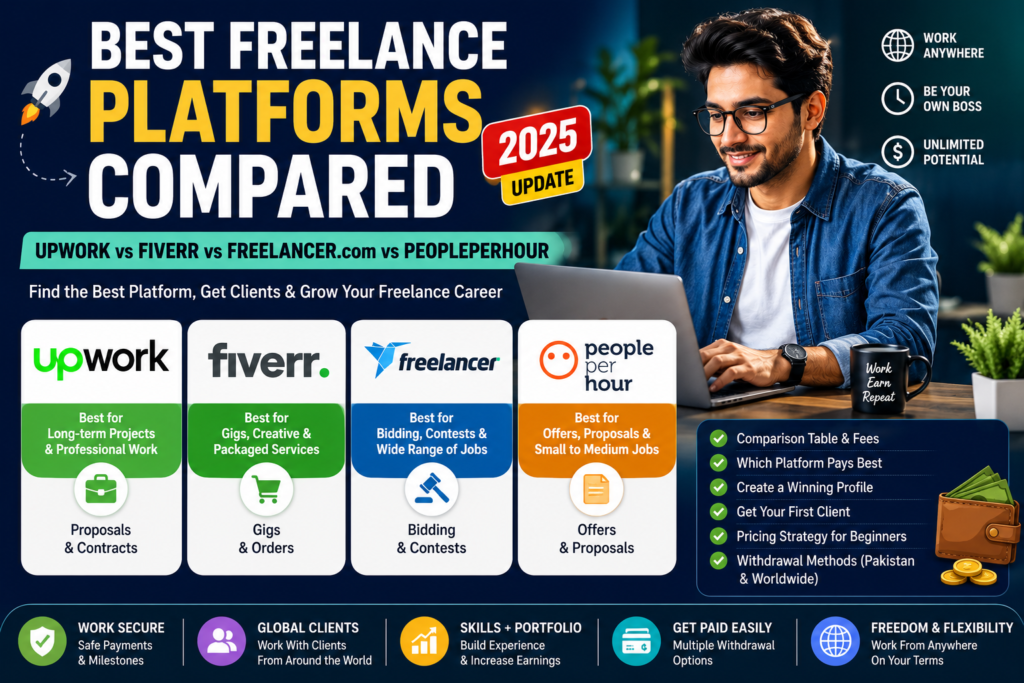
So, in this guide, I’m comparing four major platforms:
- Upwork
- Fiverr
- Freelancer.com
- PeoplePerHour
I’ll cover their fees, how they work, which one is better for beginners, how to get your first client, how much you should charge and the practical withdrawal options available to freelancers.
Best Freelance Platforms Compared (2025 Update)
There isn’t one platform that wins for everyone.
I’ve seen freelancers do extremely well on Fiverr while struggling on Upwork, and I’ve seen the opposite happen with freelancers who prefer writing proposals and pitching directly to clients.
The basic difference is how the platforms connect buyers and freelancers.
Upwork is heavily proposal-driven. Clients publish jobs and freelancers submit proposals. Upwork currently requires Connects for proposals, although freelancers may receive free Connects depending on their account and eligibility.
Fiverr works differently. You create predefined services called Gigs, and clients can discover and purchase them. This can be particularly attractive for services that are easy to package, such as logo design, video editing, WordPress fixes, article writing or social media design.
Freelancer.com combines project bidding with contests and other hiring options. Its milestone payment system is designed to hold project funds before the work is released.
PeoplePerHour combines offers and project proposals. Its freelancer commission changes depending on your lifetime billing with an individual buyer.
Here’s how I would think about them:
| Platform | Best For | Main Working Style | Freelancer Fee |
|---|---|---|---|
| Upwork | Professional services, long-term clients | Proposals | 0%–15% per contract |
| Fiverr | Packaged services, creative work | Gigs/orders | Generally 20% |
| Freelancer.com | Bidding, contests, varied projects | Bids + contests | 10% or $5 minimum |
| PeoplePerHour | UK/EU-oriented services and smaller projects | Offers + proposals | 20%, 7.5% or 3.5% depending on buyer history |
Upwork currently states that its freelancer service fee can range from 0% to 15% per contract, with the exact rate shown before you submit a proposal or accept an offer.
Freelancer.com currently charges freelancers 10% or $5, whichever is greater, on fixed-price projects, and 10% on hourly projects.
PeoplePerHour’s published structure is more unusual: 20% below £250 lifetime billing per buyer, 7.5% between £250 and £5,000, and 3.5% above £5,000, excluding VAT.
Fiverr’s standard seller commission is generally 20%, so you need to include that when setting your Gig price. Fiverr itself advises sellers to factor its 20% commission into pricing.
Upwork vs Fiverr vs Freelancer.com vs PeoplePerHour
Let’s look at the platforms individually.
Upwork
If I had to choose one platform for a freelancer who wants to build long-term professional relationships, Upwork would be one of my first choices.
You can find projects involving:
- Web development
- WordPress
- Graphic design
- SEO
- Digital marketing
- Content writing
- Virtual assistance
- Video editing
- Software development
- Data analysis
- Customer support
The biggest advantage is the ability to pitch directly to clients.
For example, suppose a company needs a WordPress developer for six months.
You can send a proposal explaining exactly how you would solve its problem.
That’s very different from simply waiting for someone to purchase a Gig.
The downside is competition.
Your first few proposals may get ignored.
That’s normal.
A common beginner mistake is sending the same generic proposal to 30 jobs.
Don’t.
If the client says, “I need someone to fix my WooCommerce checkout,” your first paragraph should demonstrate that you understood the problem.
Not:
“Dear Sir/Madam, I am a highly experienced professional and would love to work with you.”
That tells the client almost nothing.
Fiverr
Fiverr can be excellent if your service can be turned into a clear package.
For example:
I will design 5 professional Facebook posts
or:
I will fix 3 WordPress errors
or:
I will edit a 60-second YouTube video
The buyer can see your service, packages, portfolio and reviews before ordering.
That’s convenient.
The challenge is getting your Gig visible among competing sellers.
A new seller may have a great service but very little social proof.
That’s why your thumbnail, title, description and portfolio matter so much.
And remember the fee.
If you sell a $100 service and Fiverr’s standard 20% commission applies, your earnings before other applicable adjustments would be $80.
So don’t price your service at $100 if you actually need to take home $100.
Freelancer.com
Freelancer.com is more focused on bidding for projects.
It also has contests, which can be useful for designers and other creative freelancers.
Its current freelancer fee is 10% for hourly work and 10% or $5, whichever is greater, for fixed-price projects.
One interesting feature is its milestone system.
For a freelancer, having a funded milestone before starting substantial work is much safer than simply trusting a stranger’s promise to pay later.
However, the platform can feel crowded, particularly for common services.
You’ll often see many freelancers competing for the same project.
PeoplePerHour
PeoplePerHour can be interesting if you target clients in the UK and Europe or offer services that fit its marketplace.
One unusual advantage is its buyer-based fee structure.
According to PeoplePerHour’s current published fee structure, freelancers pay 20% on the first £250 of lifetime billing with a particular buyer, 7.5% from £250 to £5,000 and 3.5% above £5,000, excluding VAT.
That means the relationship can become more economical as you continue working with the same buyer.
The catch?
Getting that first buyer is still the hardest part.
Platform Comparison Table & Fees
Here’s the practical way I’d compare the four platforms.
| Feature | Upwork | Fiverr | Freelancer.com | PeoplePerHour |
|---|---|---|---|---|
| Main model | Apply to jobs | Create Gigs | Bid on projects | Offers + proposals |
| Best for | Professional/long-term work | Packaged services | Bidding + contests | UK/EU-oriented work |
| Freelancer fee | 0%–15% | Generally 20% | 10% or $5 minimum | 20% → 7.5% → 3.5% |
| Portfolio important? | Very | Very | Very | Very |
| Reviews important? | Yes | Extremely | Yes | Yes |
| Beginner friendly | Yes, but competitive | Yes | Yes | Yes |
| Direct proposals | Yes | Limited compared with Upwork | Yes | Yes |
| Long-term clients | Excellent | Good | Good | Good |
| Fixed service packages | Yes, Project Catalog | Core model | Some options | Offers |
The biggest mistake is comparing only the headline commission.
For example, paying 20% on a $1,000 project isn’t necessarily worse than paying 10% on a $1,000 project if the first platform brings you a client who stays with you for years.
Client quality matters more than a few percentage points of fees.
Which Platform Pays Best (Real Data)
This question needs a little correction.
There isn’t a reliable public dataset showing that “Upwork freelancers earn X while Fiverr freelancers earn Y” for comparable freelancers doing the same work.
Anyone giving you a simple ranking like:
- Upwork — $5,000
- Fiverr — $4,000
- Freelancer — $3,000
should be treated carefully unless they explain exactly where those numbers came from.
A better way to compare platforms is to look at what you keep after platform fees.
Suppose you complete a $1,000 project.
Upwork
If your contract has a 10% service fee, you’d keep approximately $900 before taxes and withdrawal costs.
Upwork’s actual fee can be between 0% and 15% depending on the contract.
Fiverr
At a 20% commission, a $1,000 order would leave approximately $800 before taxes and withdrawal costs. Fiverr itself advises sellers to factor the 20% commission into their pricing.
Freelancer.com
At 10%, a $1,000 project would leave approximately $900 before taxes and withdrawal costs. For smaller fixed-price projects, remember the $5 minimum can make the effective percentage much higher.
PeoplePerHour
The fee depends on your lifetime billing with that specific buyer, so the economics can improve significantly as you build a repeat relationship.
So which pays best?
For higher-value professional services and long-term contracts, I’d personally look closely at Upwork.
For repeatable packaged services, Fiverr can work very well.
For bidding and contests, Freelancer.com is worth testing.
For building repeat relationships with buyers, PeoplePerHour’s tiered commission can become attractive.
Don’t choose purely based on commission.
Choose based on where you can consistently acquire good clients.
How to Create a Winning Freelance Profile
Your profile is basically your sales page.
And here’s something I learned after looking at hundreds of freelance profiles:
Most beginners talk about themselves too much.
They write:
“I am hardworking, passionate, dedicated and highly motivated.”
Every freelancer says that.
Instead, talk about the client’s problem.
For example:
Weak profile
I am a professional graphic designer with five years of experience. I am hardworking and provide high-quality services.
Better profile
I help e-commerce businesses create clean product graphics, Facebook ads and social media designs that are ready to publish.
The second version immediately tells me:
Who do you help?
What do you do?
What can I hire you for?
Your profile should contain:
1. A professional photo
Use a clear, recent image with good lighting.
2. A specific headline
Don’t write:
Freelancer
Write:
WordPress Developer | Elementor | WooCommerce | Speed Optimization
3. A client-focused overview
Explain what you solve.
4. Relevant portfolio samples
Five excellent samples are better than 30 average ones.
5. Skills
Only list skills you can actually demonstrate.
6. Clear communication
Your written English matters if you’re targeting international clients.
You don’t need fancy English.
You need clear English.
First Project: How to Get Your First Client
Your first client is usually harder than your tenth.
Why?
Because you have no reviews.
Clients don’t know whether you’re reliable.
So your objective isn’t necessarily to make a huge amount of money from the first project.
Your first objective is to create proof.
Let’s say you are a beginner WordPress developer.
Instead of waiting for someone to hire you, create three sample projects:
- Business website
- WooCommerce store
- Landing page
Then create screenshots and explain what you built.
Now your profile doesn’t say:
“I have no experience.”
It says:
“Here are three examples of my work.”
That is a massive difference.
For Upwork
Search for jobs that:
- Match your exact skill
- Have realistic requirements
- Have a clear description
- Don’t attract thousands of applicants
- You can genuinely complete
Read the entire job post.
Then write a customized proposal.
A simple structure works:
Opening: Show you understand the problem.
Solution: Explain what you would do.
Proof: Show a relevant sample.
Question: Ask one useful question.
CTA: Suggest the next step.
Don’t write a 700-word essay.
Clients are busy.
For Fiverr
Focus heavily on your Gig presentation.
Your:
- Thumbnail
- Title
- Description
- Packages
- FAQ
- Portfolio
- Reviews
all work together.
Don’t create 20 random Gigs.
Start with a few services you can deliver extremely well.
For Freelancer.com
Don’t bid on everything.
Look for projects where your portfolio directly matches the requirements.
For PeoplePerHour
Make your offers specific.
A buyer should immediately understand what they’re getting, what it costs and what they need to provide.
Pricing Strategy for Beginners
This is another place where beginners often make a huge mistake.
They think:
“I’m new, so I need to be extremely cheap.”
Not necessarily.
Being cheap can actually attract difficult clients.
If you charge $5 for a job that realistically takes three hours, you haven’t created a sustainable freelance business.
Start with a price that makes sense for your time and skill.
For example, if your target income is $15 per hour and a project takes four hours:
4 × $15 = $60
Now add time for:
- Client communication
- Revisions
- Research
- Platform fees
- Payment costs
- Unexpected problems
You might decide that a $75–$90 project price makes more sense.
Don’t forget platform fees
Suppose you want to receive approximately $80 after a 20% platform fee.
You shouldn’t simply charge $80.
At a 20% fee, you’d need to charge about:
$100
because:
$100 − 20% = $80
This is basic math, but it’s surprisingly easy to forget when you’re excited about getting your first order.
Use packages
Instead of:
Logo Design — $20
Try:
Basic — $30
1 concept, PNG/JPG
Standard — $70
3 concepts, source file, revisions
Premium — $120
Multiple concepts, source files, brand variations
Packages make comparison easier for buyers.
And once you have reviews and repeat customers, increase your prices gradually.
Withdrawal Methods: Direct to Pakistan & Worldwide
Getting the client is only half the job.
You also need to get your money out.
This is particularly important for freelancers in Pakistan.
Upwork → Pakistani Bank
Upwork currently supports Direct to Local Bank withdrawals in Pakistan.
Its documentation lists a $0.99 USD fee per Direct to Local Bank withdrawal, with Pakistan currently shown with a $5 minimum and $8,999 maximum for this withdrawal method. Upwork also notes that bank-specific fees or restrictions may apply.
This is potentially one of the simplest options because the money goes directly to your local bank.
You need to make sure your account information is correct.
More importantly, the beneficiary name should match your verified Upwork identity.
Upwork → Payoneer
Upwork also supports Payoneer for freelancers outside the U.S. and India.
Upwork says the Payoneer account must be your own verified account and the name needs to match your verified Upwork name.
For many international freelancers, Payoneer can be useful when direct bank options aren’t convenient.
Fiverr → Payoneer
Fiverr currently offers payout options including:
- PayPal
- Bank transfer via Payoneer
- Payoneer account
- Fiverr Revenue Card for existing cardholders
Fiverr’s current help documentation lists bank transfer via Payoneer at 1–3 business days in local currency or 5–7 business days for USD wire, with applicable fees and minimum withdrawal amounts depending on the method.
Fiverr also states that Payoneer can be used to withdraw to a local bank account where supported.
For Pakistani freelancers, availability can depend on the specific account and provider requirements, so always check what your Fiverr account currently offers before promising yourself a particular withdrawal route.
Worldwide Withdrawals
Outside Pakistan, your options can include:
- Local bank transfers
- PayPal
- Payoneer
- Wise or other supported banking services
- International wire transfers
But availability varies by country.
Don’t create a payment account using somebody else’s identity just because you’re having trouble with withdrawals.
That can create verification problems later.
Use payment accounts that belong to you and match your verified freelance profile wherever the platform requires it.
Common Freelancing Mistakes I Would Avoid
After comparing these platforms, there are several mistakes I would actively avoid.
Creating accounts on every platform
Start with one or two.
Learn how they work.
Build reviews.
Then expand.
Copying other freelancers’ profiles
Study competitors, but don’t copy their wording or portfolio.
Develop your own positioning.
Offering everything
“I’m a writer, designer, developer, marketer, translator, SEO expert and video editor.”
That sounds like you don’t specialize in anything.
Choose a core service.
Sending generic proposals
A generic proposal tells the client you didn’t read the project.
Customize it.
Working before payment protection is established
Don’t accept “I’ll pay you when the client pays me.”
Use the platform’s official payment and milestone systems where appropriate.
Taking clients off-platform too early
Trying to avoid platform fees can put your account and payment at risk.
Follow the platform’s rules.
Charging too little
Low prices aren’t a substitute for a weak portfolio.
Improve the portfolio first.
So, Which Freelance Platform Should You Choose?
If I were starting again, I wouldn’t ask:
“Which website makes the most money?”
I’d ask:
“Where does my service fit best?”
For web development, programming, SEO, marketing, consulting and long-term professional work, I’d start by testing Upwork.
For graphic design, video editing, voiceovers, writing and clearly packaged services, Fiverr is worth serious consideration.
For project bidding and design contests, Freelancer.com can be useful.
For offers, proposals and repeat buyer relationships, PeoplePerHour is another option.
And there’s nothing wrong with testing two platforms for 30–60 days and tracking your results.
Create a simple spreadsheet with:
- Proposals sent
- Gigs created
- Views
- Replies
- Interviews
- Orders
- Revenue
- Platform fees
- Withdrawal costs
- Repeat clients
After a couple of months, you’ll have something much more useful than someone’s “Top 10 Freelance Websites” list.
You’ll have your own data.
And that’s ultimately how I’d approach freelancing.
Don’t chase every platform.
Pick a service, build proof, create a professional profile, contact the right clients, deliver excellent work and slowly increase your prices.
The first client might take longer than you expect.
The second is usually easier.
By the time you have ten happy clients and a strong portfolio, the question changes from:
“Where can I find work?”
to:
“Which clients are actually worth working with?”
That’s a much better problem to have.