
I still remember the first time I tried learning programming seriously.
I opened a Python tutorial, watched about 40 minutes, understood almost nothing, then jumped to a JavaScript course because someone online said JavaScript was “the best language.” A few days later, I was watching videos about AI, then WordPress, then app development.
After a couple of weeks, I had learned a little bit of everything and could build almost nothing.
That is probably the biggest problem beginners face with coding.
The problem usually isn’t a lack of courses. It’s having too many choices and no clear path.
In 2025, learning to code is arguably more accessible than ever. You have interactive platforms such as Codecademy, enormous course libraries such as Udemy, structured programs on Coursera, and free learning paths from freeCodeCamp. At the same time, AI coding tools have changed how developers learn and work.
But that doesn’t mean becoming a professional developer has become easy.
The people who make progress are usually the ones who stop collecting tutorials and start building things.
So if you’re starting from zero, which language should you learn? Which platform is worth paying for? How long does it realistically take? Do you need a university degree? And what kind of salary can you expect from your first coding job?
Let’s break it down.
Why Learn Coding in 2025? (Job Market Analysis)
If you look at the U.S. software development market, the numbers still make coding an attractive career.
The U.S. Bureau of Labor Statistics projects employment for software developers, quality assurance analysts and testers to grow 15% from 2024 to 2034, compared with 3% growth for all occupations. The same occupational group is projected to have around 129,200 openings per year on average over that period. (Bureau of Labor Statistics)
Software developers also had a $133,080 median annual wage in May 2024 in the United States. That’s a median for the entire occupation, however—not what a beginner should expect immediately after finishing a coding course. (Bureau of Labor Statistics)
Web development is another accessible route. BLS reports a $90,930 median annual wage for web developers in May 2024 and projects 7% employment growth for web developers and digital designers between 2024 and 2034. (Bureau of Labor Statistics)
The other reason I think coding remains valuable is that the role itself is changing.
AI hasn’t simply made programming disappear.
Instead, developers are increasingly using AI tools to generate boilerplate code, explain unfamiliar code, debug problems and speed up repetitive work.
Stack Overflow’s 2025 Developer Survey found that 84% of respondents were using or planning to use AI tools in their development process, while 51% of professional developers reported using AI tools daily. At the same time, only about 69% of AI-agent users agreed that agents increased their productivity. (Stack Overflow Insights)
That’s an important distinction.
AI can help you write code faster.
It doesn’t automatically teach you:
- What should be built
- Why the code works
- Whether the output is secure
- Whether the architecture makes sense
- How to debug a broken application
- How to communicate with a client
- How to maintain software six months later
In fact, Stack Overflow’s 2025 survey reported that Python adoption increased by seven percentage points compared with 2024, highlighting its continued importance in AI, data science and backend development. (Stack Overflow Insights)
So I wouldn’t learn coding because you expect to type code manually for eight hours a day forever.
I’d learn it because understanding technology gives you the ability to build, automate, troubleshoot and work effectively with AI-powered tools.
Codecademy vs Udemy vs Coursera vs freeCodeCamp
This is where beginners can waste a lot of money.
You don’t need four subscriptions.
You need one learning path that you’ll actually finish.
Codecademy
Codecademy is one of my favorite options for people who hate watching hours of video tutorials.
The major advantage is interactive learning.
You write code directly in the browser and immediately see whether it works.
That’s useful when you’re learning concepts such as:
variables
functions
loops
arrays
objects
classes
Codecademy’s current Basic plan is free. Its current Plus and Pro plans add features such as projects, quizzes and broader course/path access. The listed U.S. pricing is $14.99/month for Plus when billed annually or $29.99 monthly, while Pro is $19.99/month annually or $39.99 monthly. (Codecademy)
Best for: Beginners who learn by doing.
Udemy
Udemy is different.
There are thousands of individual coding courses, and you can buy a course specifically for the technology you want to learn.
For example:
- Python
- JavaScript
- React
- Node.js
- PHP
- Flutter
- Java
- C#
- SQL
Udemy currently offers individual courses with one-time pricing, while its Personal Plan provides access to a curated collection of courses through a subscription. (Udemy)
The biggest advantage is choice.
The biggest disadvantage is also choice.
You can easily buy a 40-hour course, watch six hours and never open it again.
Best for: Learners who want a specific course or instructor.
Coursera
Coursera is better suited to people who prefer structured programs.
Instead of randomly jumping between individual courses, you can follow professional certificates and specialization-style learning paths.
It can also be useful if you want credentials from recognizable universities or companies.
Best for: Structured career learning and professional certificates.
freeCodeCamp
If your budget is basically zero, don’t assume you can’t learn properly.
freeCodeCamp offers free coding education and certifications. Its newer certification structure includes large blocks of coursework, projects and exams rather than simply watching videos. (The freeCodeCamp Forum)
That’s one reason I recommend freeCodeCamp to beginners who are willing to be disciplined.
You can combine it with:
- YouTube
- Official documentation
- GitHub
- Stack Overflow
- VS Code
and build a surprisingly strong learning environment without paying for an expensive bootcamp.
My simple comparison
| Platform | Best For | Cost Approach | Learning Style |
|---|---|---|---|
| Codecademy | Interactive beginners | Free + paid plans | Hands-on |
| Udemy | Specific technologies | Individual courses/subscription | Video + exercises |
| Coursera | Structured career paths | Courses/subscriptions | Structured |
| freeCodeCamp | Budget learners | Free | Interactive + projects |
If I were starting from zero today, I’d probably choose freeCodeCamp or Codecademy for fundamentals, then use Udemy or Coursera when I needed deeper instruction in a particular technology.
Best Coding Languages to Learn First
This is where I would avoid giving you the usual answer:
“Learn Python because it’s the best.”
There isn’t a best programming language.
There is a best language for your goal.
Python
If you’re completely unsure what you want to do, Python is probably the safest starting point.
It’s relatively readable and useful across:
- Automation
- AI
- Machine learning
- Data analysis
- Backend development
- Scripting
- APIs
Python’s momentum was particularly noticeable in Stack Overflow’s 2025 survey, where its adoption increased significantly year over year. (Stack Overflow Insights)
My rating for beginners: 9/10
JavaScript
If you want to build websites, JavaScript is extremely important.
You’ll typically encounter:
HTML → CSS → JavaScript → React/Next.js → Backend
JavaScript is also useful beyond browsers through technologies such as Node.js.
Best for: Web development.
Beginner rating: 9/10
TypeScript
Don’t necessarily start with TypeScript on day one.
Learn JavaScript first.
Once you’re comfortable with JavaScript, TypeScript becomes much easier.
It is increasingly common in professional web development because it adds static typing to JavaScript.
Best for: Serious modern web development.
Java
Java remains relevant in enterprise software, backend development and Android-related ecosystems.
It’s more verbose than Python, but learning it can teach you useful programming concepts.
Best for: Enterprise/backend development.
C#
If you’re interested in Microsoft technologies, enterprise applications or game development with Unity, C# is worth considering.
Best for: .NET and game development.
C/C++
These are not the languages I’d recommend as a first choice for someone who simply wants to become employable quickly.
But they are valuable for:
- Systems programming
- Embedded systems
- Game engines
- Performance-critical applications
My recommendation
If you have absolutely no idea what you want:
Start with Python.
If you know you want websites:
Start with HTML + CSS + JavaScript.
If you want AI/data:
Python + SQL.
If you want Android/backend/enterprise:
Java or Kotlin + SQL.
The important part is not choosing the perfect language.
It’s staying with one long enough to become comfortable.
Complete Learning Path: Timeline & Cost
Here’s the roadmap I would use for someone starting from zero.
Month 1: Programming Fundamentals
Learn:
- Variables
- Data types
- Conditions
- Loops
- Functions
- Lists/arrays
- Dictionaries/objects
- Basic error handling
Don’t worry about frameworks.
Your only goal is to understand programming logic.
Estimated cost: $0–$40
Month 2: Build Small Programs
Stop following tutorials constantly.
Build:
- Calculator
- Number guessing game
- To-do list
- Password generator
- Simple expense tracker
- Unit converter
These projects will expose gaps in your knowledge.
That’s good.
When your program breaks, you’ll actually have a reason to learn debugging.
Months 3–4: Choose a Specialization
Now decide what you want to build.
Web Development
Learn:
- HTML
- CSS
- JavaScript
- Git/GitHub
- React
- APIs
Python Backend
Learn:
- Python
- Git
- SQL
- APIs
- FastAPI or Django
Data/AI
Learn:
- Python
- SQL
- NumPy
- pandas
- Visualization
- Machine learning fundamentals
Don’t attempt all three simultaneously.
Months 5–6: Build Portfolio Projects
This is where your learning changes.
Instead of:
“I completed a Python course.”
you want to be able to say:
“I built a web application that does X.”
That is much stronger.
Months 6–12: Job Preparation
At this stage, focus on:
- GitHub
- Resume
- Interview questions
- Data structures
- Algorithms
- System basics
- Real projects
- Freelance applications
- Internships
Six months can be enough to build a foundation.
It does not mean everyone becomes job-ready in exactly six months.
Some people need nine months.
Others need 18 months.
Don’t compare your timeline with someone else’s.
Bootcamp vs Self-Study vs University Degree
I’ve seen people argue about this as if there is one correct answer.
There isn’t.
Self-Study
Cost: Lowest
Flexibility: Excellent
Main problem: Discipline
Self-study is fantastic if you’re good at organizing yourself.
You can learn through freeCodeCamp, documentation, YouTube, GitHub and other resources without paying thousands of dollars.
The problem is that nobody forces you to continue.
Bootcamp
Cost: Usually much higher
Flexibility: Lower
Advantage: Structure and support
A good bootcamp can save time because someone has already organized the curriculum.
But don’t choose a bootcamp just because its advertisement says:
“Become a developer in 12 weeks!”
Ask about:
- Curriculum
- Instructor experience
- Projects
- Career support
- Refund policy
- Graduate outcomes
- Total cost
University Degree
Cost: Highest in many countries
Time: Usually several years
Advantage: Broad foundation
A computer science degree can teach algorithms, operating systems, databases, networking, mathematics, software engineering and theoretical foundations.
It also helps for jobs where employers explicitly require a bachelor’s degree.
The interesting part is that even the BLS notes that web developer education requirements can range from a high school diploma to a bachelor’s degree, while software developers typically need a bachelor’s degree. (Bureau of Labor Statistics)
So the answer depends heavily on the job you’re targeting.
My recommendation
If you’re already in university:
Don’t drop your degree just because you discovered coding.
Learn coding alongside it.
If you can’t afford university:
Self-study + portfolio + freelance work can still create a path into tech.
If you have money and need structure:
A reputable bootcamp can accelerate learning, but research it carefully.
Portfolio Projects That Get You Hired
This is probably the most important section in the entire article.
A portfolio shouldn’t contain 10 versions of a calculator.
Build projects that demonstrate real-world thinking.
Project 1: E-commerce Website
Build:
- Product listing
- Search
- Filters
- Shopping cart
- Checkout mockup
- Responsive design
This demonstrates frontend skills.
Project 2: Business Dashboard
Create a dashboard that analyzes sales data.
Use:
- Python
- pandas
- SQL
- Charts
This demonstrates analytical ability.
Project 3: Full-Stack Task Manager
Build:
- User registration
- Login
- Create task
- Edit task
- Delete task
- Database
- API
This demonstrates backend and frontend integration.
Project 4: AI-Powered Application
Don’t just make another chatbot.
Build something useful.
For example:
AI Study Assistant
A student uploads notes and asks questions about them.
This can demonstrate:
- Frontend
- Backend
- APIs
- Authentication
- AI integration
- Database usage
Project 5: Solve a Real Problem
This is my favorite approach.
Find an annoying problem around you.
Maybe a local business needs:
- Inventory tracking
- Appointment management
- Invoice generation
- Customer database
- Social media reporting
Build a simple version.
Now you aren’t just demonstrating coding.
You’re demonstrating problem-solving.
Salary After Learning Coding (First Job)
This is where you need to ignore the exaggerated YouTube thumbnails.
You probably won’t finish a six-month course and immediately receive a $150,000 salary.
The U.S. BLS reports that software developers had a $133,080 median annual wage in May 2024, but that figure includes the entire profession, from relatively new developers to highly experienced engineers. (Bureau of Labor Statistics)
The same source reports a median of $90,930 for web developers in May 2024. (Bureau of Labor Statistics)
Those are useful benchmarks, not beginner guarantees.
Your first salary can vary dramatically depending on:
- Country
- City
- Company
- Degree
- Portfolio
- Interview performance
- Technology stack
- Internship experience
- Previous professional experience
For someone starting in a lower-cost market, the first salary may look modest compared with U.S. numbers.
But don’t look only at the first paycheck.
Look at the progression.
A beginner might start as:
Junior Developer → Developer → Mid-Level Developer → Senior Developer
or:
Intern → Junior Engineer → Software Engineer → Senior Engineer
The difference between year one and year five can be enormous.
And freelancing creates another path.
You can eventually work with international clients rather than depending entirely on your local job market.
Transition from Beginner to Professional Developer
This is the part that separates people who “learn coding” from people who actually become developers.
Stage 1: Tutorial Beginner
You can follow someone else’s code.
That’s not enough.
Stage 2: Independent Beginner
You can build small projects without copying every line from a tutorial.
This is a major milestone.
Stage 3: Junior Developer
You can:
- Use Git
- Read documentation
- Debug problems
- Work with APIs
- Use databases
- Write reasonably clean code
- Understand basic testing
- Collaborate with others
Stage 4: Professional Developer
Now you’re thinking beyond individual features.
You start asking:
- Will this scale?
- Is this secure?
- Is this maintainable?
- What happens if the API fails?
- How should the database be structured?
- How will another developer understand this code?
That’s professional thinking.
And it doesn’t happen because you watched one more course.
It happens because you’ve built enough things to encounter real problems.
Don’t Learn Coding Without Learning Git
One mistake I see beginners make is treating GitHub as a place to upload code at the very end.
Don’t.
Learn Git early.
Understand:
git init
git add
git commit
git push
git pull
git branch
You don’t need to memorize every Git command.
You need to understand version control.
GitHub is also useful as a public portfolio.
Your repositories don’t need to be perfect.
But they should show consistent work.
Stack Overflow’s 2025 Developer Survey also found GitHub had become the most desired collaboration/documentation tool in its category, overtaking Jira in that ranking. (Stack Overflow Insights)
How AI Changes the Way You Should Learn Coding
This is one area where I’d change the traditional advice.
Don’t avoid AI completely.
But don’t let AI become your brain.
Use tools such as ChatGPT or other AI coding assistants to:
- Explain errors
- Explain unfamiliar code
- Generate test cases
- Suggest debugging approaches
- Compare two approaches
- Help you understand documentation
- Generate boilerplate after you understand the requirements
But try this:
Write the solution yourself first.
Get stuck.
Then ask AI for a hint.
If you immediately paste the entire assignment into an AI tool and copy the answer, you’ll finish the assignment faster—but learn considerably less.
There’s evidence that developers are already deeply integrating AI into their workflows. Stack Overflow’s 2025 survey found 84% of respondents were using or planning to use AI tools in development. (Stack Overflow Insights)
The skill of the future isn’t simply:
“Can you write code?”
It’s increasingly:
“Can you understand a problem, design a solution, use AI intelligently, verify the output and maintain the resulting software?”
That’s a much more useful skill.
Common Mistakes Beginners Should Avoid
Jumping between languages
Python today.
Java tomorrow.
C++ next week.
JavaScript after that.
Stop.
Choose one.
Watching instead of building
Five hours of tutorials don’t equal five hours of programming practice.
Copying projects
If your portfolio contains a Netflix clone that you copied from YouTube, don’t expect it to impress experienced developers.
Build something different.
Ignoring errors
Errors aren’t evidence that you’re bad at programming.
They’re part of programming.
Learn to read them.
Avoiding documentation
Professional developers constantly read documentation.
Stack Overflow’s 2025 survey found technical documentation was the most-used learning resource among respondents, with nearly 68% reporting using it in the past year. (Stack Overflow Insights)
Learning everything before applying
You don’t need to know every framework before applying for your first junior role.
Learn the fundamentals.
Build projects.
Apply.
Continue learning.
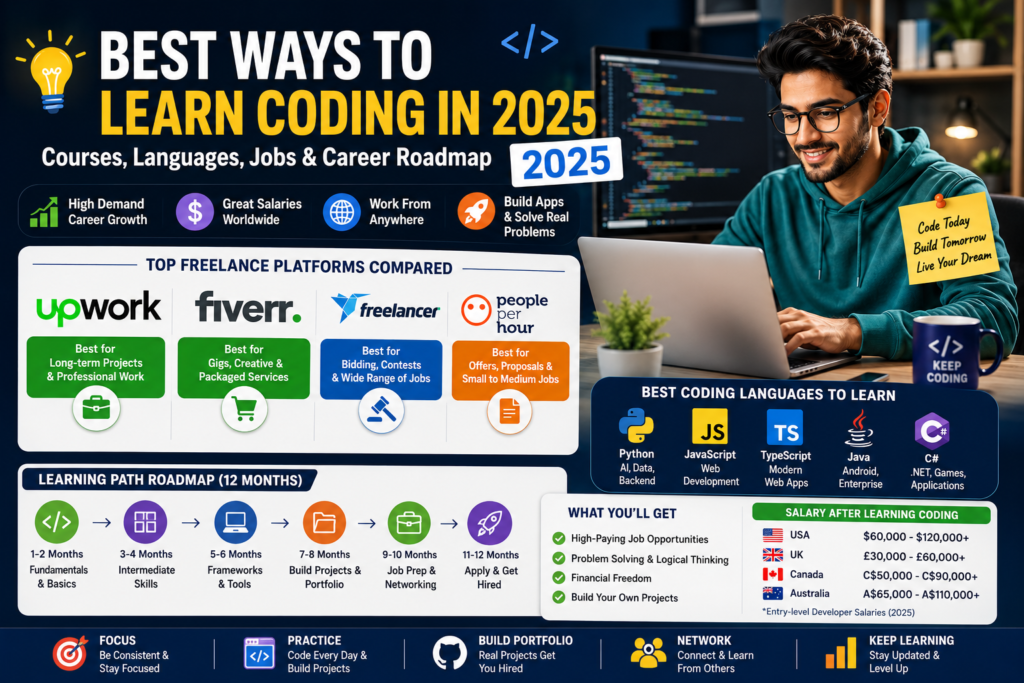
A Realistic 12-Month Coding Roadmap
If I were starting completely from zero today, this is the path I’d follow:
| Period | Main Goal |
|---|---|
| Month 1 | Programming fundamentals |
| Month 2 | Small coding projects |
| Month 3 | Git + GitHub + intermediate programming |
| Month 4 | Choose specialization |
| Months 5–6 | Frameworks + APIs + databases |
| Months 7–8 | Build 2–3 serious projects |
| Months 9–10 | Portfolio + resume + LinkedIn |
| Months 11–12 | Applications + interviews + freelance work |
The timeline isn’t a guarantee.
Some people will reach employable level sooner.
Others will need longer.
The important thing is that every month should produce something tangible.
Not another certificate.
Not another bookmarked tutorial.
Something you built.
Final Thoughts: Don’t Wait Until You Feel Ready
If you are sitting there thinking:
“I want to learn coding, but I don’t know where to start.”
Start smaller than you think.
Install VS Code.
Choose Python or JavaScript.
Spend 30–60 minutes learning the basics.
Then build something ridiculously simple.
A calculator.
A to-do list.
A personal website.
A small automation script.
Your first projects will probably be ugly.
Mine were.
You’ll write code that looks terrible six months later.
That’s actually a good sign.
It means you’ve improved enough to recognize what was wrong with your old code.
And that’s what learning to code really looks like.
You don’t go from beginner to professional in one giant jump.
You go from “I don’t understand this” to “I can probably figure this out.”
Then eventually to:
“Give me the problem. I’ll build the solution.”
That’s the transition that turns coding from a course you’re taking into a professional skill you can actually use.