
The first time I helped someone troubleshoot a computer problem, it wasn’t anything complicated.
The Wi-Fi wasn’t working.
We restarted the router, checked the network settings, and eventually discovered the Ethernet cable wasn’t connected properly.
It sounds almost funny, but that’s actually a good introduction to IT support.
A lot of IT work isn’t about writing complicated code or sitting in front of a server all day. It’s about finding problems, understanding what went wrong, explaining the solution clearly, and preventing the same issue from happening again.
That’s why IT support remains an interesting entry point into the technology industry.
The Google IT Support Professional Certificate is particularly popular with beginners because it doesn’t require previous IT experience. Google’s current program covers troubleshooting, networking, operating systems, system administration and security, and is designed for introductory IT-support roles. (Grow with Google)
But there’s a lot more to consider than simply earning the certificate.
Can it actually help you get a job? Is it better than CompTIA A+? How much can you earn? Can you work remotely? And how long might it take before your first paycheck?
Let’s look at it realistically.
What is IT Support & Why is It in Demand?
IT support is basically the layer between people and technology.
When an employee can’t log into their computer, a printer stops working, software crashes, an account needs to be configured, or someone can’t connect to the company’s network, IT support is often the first place they go.
Typical IT support work can include:
- Troubleshooting computers
- Installing software
- Setting up user accounts
- Managing passwords
- Troubleshooting networks
- Supporting Windows and Linux systems
- Configuring hardware
- Removing common software problems
- Helping employees remotely
- Documenting technical issues
- Escalating complicated problems
The Google IT Support Certificate specifically covers areas including technical support, networking, operating systems, system administration and IT security. Google says no relevant experience is required and that the program can be completed online at your own pace. (Grow with Google)
One thing I would correct from some older articles about IT support is the idea that the field is simply “exploding.”
The U.S. Bureau of Labor Statistics actually projects overall employment for computer support specialists to decline 3% from 2024 to 2034. But that doesn’t mean there will be no jobs. BLS still projects approximately 50,500 openings per year, largely because workers leave occupations or move into other roles. (Bureau of Labor Statistics)
That’s an important distinction.
IT support isn’t necessarily a career where you should expect unlimited growth in the exact same help-desk role.
Instead, think of it as a starting point into the wider IT industry.
You can potentially move from:
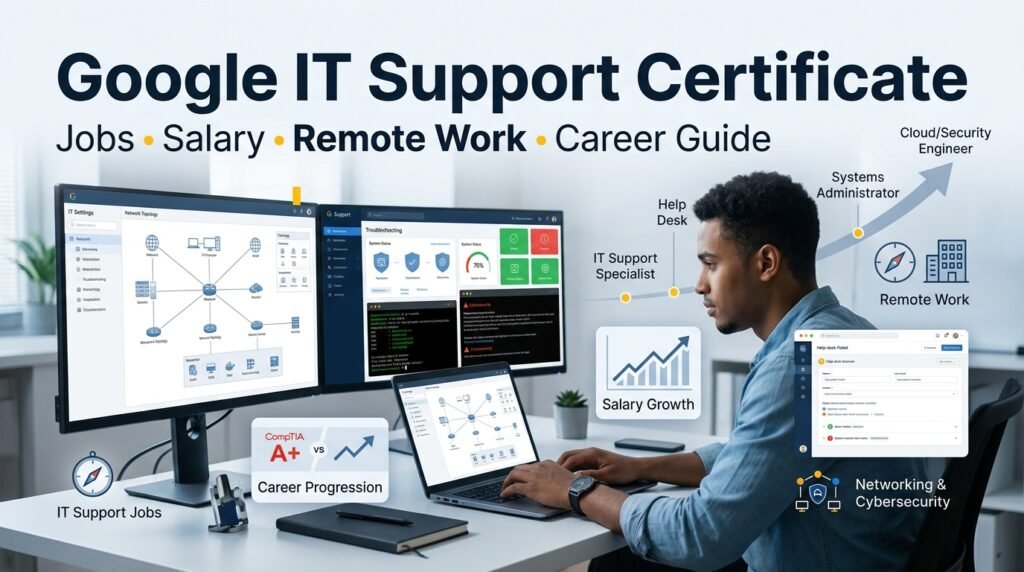
Help Desk → IT Support Specialist → Systems Administrator → Cloud/Network/Security
That career progression is one of the biggest reasons I find IT support interesting.
Google IT Support Certificate vs CompTIA A+
This is probably the most common comparison beginners ask about.
The short answer is:
They’re useful for different reasons.
The Google certificate is designed as a beginner-friendly learning program.
CompTIA A+ is an industry certification built around core IT-support skills and certification exams.
Google IT Support Certificate
Google’s program is designed for people with little or no IT background.
The current curriculum covers:
- Technical support fundamentals
- Networking
- Operating systems
- System administration
- IT security
Google’s current information describes the program as five courses and approximately 240 hours in some regional program listings. (Grow with Google)
It’s a good option if you’re thinking:
“I don’t know anything about IT. I need someone to teach me from the beginning.”
CompTIA A+
CompTIA A+ takes a certification-exam approach.
The current A+ certification requires candidates to pass two exams, Core 1 and Core 2, covering areas such as hardware, networking, operating systems, security, troubleshooting and operational procedures. CompTIA describes A+ as its industry-standard credential for starting an IT career.
That’s useful because many employers recognize the A+ name.
So which should you choose?
If you’re completely new:
Google IT Support → learn fundamentals → practice → consider A+
is a perfectly reasonable route.
If you already understand computers and specifically want a widely recognized IT certification:
CompTIA A+ may make more sense.
And there’s nothing wrong with doing both.
In fact, they can complement each other.
The Google certificate can help you understand the concepts, while A+ gives you a separate certification target and exam experience.
Job Roles You Can Apply For (Global Market)
Don’t search only for “IT Support Specialist.”
Companies use different titles for almost identical work.
Try searching for:
Help Desk Technician
Usually handles first-line technical support.
You’ll answer user questions, troubleshoot common problems and escalate complicated issues.
IT Support Technician
A broader support role that can involve hardware, software, networking and user accounts.
Desktop Support Technician
Often involves supporting computers and employees directly.
Technical Support Specialist
This can involve troubleshooting a company’s particular software or technical product.
IT Service Desk Analyst
Common in larger organizations with formal IT service-management processes.
IT Support Analyst
Often combines troubleshooting with documentation, systems and user support.
Junior Systems Administrator
This is a more advanced direction.
You might work with:
- Servers
- User permissions
- Active Directory
- Backups
- Networking
- System monitoring
IT Operations Assistant
Another possible entry point, particularly in larger organizations.
The Google certificate itself doesn’t guarantee qualification for all of these jobs.
Your skills and experience still matter.
But these are the kinds of job titles I’d search after completing the program.
Salary Comparison: Entry Level to Senior
Salary is where you need to be careful with online course advertisements.
You may see someone claim:
“Google IT Certificate → $100,000 IT salary.”
That’s possible somewhere in the IT career path, but it is not a realistic expectation for a beginner’s first help-desk job.
The U.S. Bureau of Labor Statistics reports a $60,340 median annual wage for computer user support specialists as of May 2024. The lowest 10% earned less than $38,780, while the highest 10% earned more than $98,010. (Bureau of Labor Statistics)
For computer network support specialists, the May 2024 median was higher at $73,340, with the top 10% earning more than $124,470. (Bureau of Labor Statistics)
For comparison, network and computer systems administrators had a $96,800 median annual wage in May 2024, with the highest 10% earning more than $150,320. (Bureau of Labor Statistics)
That shows the potential progression.
| Career Stage | Example U.S. Salary Benchmark |
|---|---|
| Entry-level IT support | Often below overall occupation median |
| Computer user support specialist | $60,340 median |
| Network support specialist | $73,340 median |
| Systems administrator | $96,800 median |
| Senior/specialized IT roles | Can exceed $100K |
These are occupational medians, not guaranteed salaries for Google certificate holders.
Your actual pay depends on:
- Location
- Experience
- Certifications
- Industry
- Company size
- Technical skills
- Shift requirements
- Cloud/network/security knowledge
And if you’re applying from Pakistan, don’t compare a U.S. salary directly with a Pakistani entry-level salary.
The market is completely different.
Remote Work Opportunities – Best Countries
One of the biggest attractions of IT support is remote work.
And yes, remote IT support jobs exist.
But there’s an important misunderstanding.
Remote doesn’t always mean worldwide.
A company might advertise:
Remote – United States
That could still require you to live in the U.S.
Other companies might hire remote employees within:
- United States
- Canada
- United Kingdom
- Australia
- European countries
while limiting applicants to specific regions.
Google itself describes its IT Support Certificate as fully online, and its UK program says learners can complete it remotely at their own pace. (Grow with Google)
For someone in Pakistan, I’d search specifically for:
Worldwide Remote IT Support
Remote Technical Support Contractor
Remote Help Desk
Remote IT Support – International
Technical Support Specialist – Remote
Customer Technical Support
The last category is particularly interesting.
Some software companies hire technical-support employees who don’t necessarily need to be traditional system administrators.
They need people who can understand the product and help customers solve problems.
What Skills Make Remote IT Support Easier?
If your goal is remote work, don’t stop at the Google certificate.
Learn:
Windows
Understand:
- User accounts
- Device settings
- File permissions
- Basic troubleshooting
- Event Viewer
- Networking commands
Linux
Learn basic terminal commands.
For example:
pwd
ls
cd
mkdir
cp
mv
rm
grep
You don’t need to become a Linux administrator immediately.
Just become comfortable navigating a Linux system.
Networking
Understand:
- IP addresses
- DNS
- DHCP
- Routers
- Switches
- VPNs
- TCP/IP
- Ports
Active Directory
If you’re targeting corporate IT support, learning the basics of Active Directory can be extremely useful.
Ticketing Systems
Learn how support teams document issues.
Examples include:
- Jira Service Management
- ServiceNow
- Zendesk
- Freshservice
Remote Support
Understand how remote desktop and remote troubleshooting work.
And don’t underestimate communication.
BLS specifically highlights communication and problem-solving skills for IT-related roles. (Bureau of Labor Statistics)
A technically brilliant person who can’t explain a problem to a frustrated employee isn’t necessarily a great support technician.
How Long Does It Take to Get Job After Certificate?
This is one of those questions where anyone giving you an exact answer is probably oversimplifying things.
There is no rule like:
“Finish Google IT Support → get a job in 30 days.”
Google says its Career Certificates can be completed in roughly six months with under 10 hours of study per week, while some regional IT Support pages describe completion in under six months. (Grow with Google)
But finishing the course and getting hired are two separate things.
A realistic process could look like:
Months 1–2
Learn:
- Hardware
- Operating systems
- Networking basics
- Troubleshooting
Months 3–4
Practice:
- Linux
- Windows administration
- Networking
- Security
- Troubleshooting scenarios
Months 4–6
Build a small portfolio and begin applying.
After certification
Apply consistently while improving your skills.
Some people might find work quickly.
Others may need several months.
Your results will depend heavily on whether you have practical evidence rather than just the certificate.
Build an IT Support Portfolio
This might sound strange.
“Why would an IT support technician need a portfolio?”
Because you need a way to demonstrate what you can actually do.
Create practical projects such as:
Project 1: Windows Troubleshooting Lab
Document common problems and solutions.
For example:
- DNS issue
- Network adapter problem
- User-account problem
- Software installation issue
Take screenshots and explain your troubleshooting process.
Project 2: Linux Server Lab
Set up a Linux virtual machine using VirtualBox or another virtualization platform.
Practice:
- Creating users
- File permissions
- Installing software
- Managing services
- Checking logs
Project 3: Small Network Lab
Use tools such as Cisco Packet Tracer to simulate:
- Router
- Switch
- Multiple computers
- IP addressing
- DHCP
- DNS
Project 4: Help Desk Simulation
Create a fake ticket system.
For example:
Ticket #001
User cannot connect to Wi-Fi.
Then document:
Issue → Diagnosis → Troubleshooting → Resolution → Prevention
This shows employers that you understand the actual support workflow.
Real Interview Questions & Preparation Tips
IT support interviews are often less intimidating than they look.
You don’t necessarily need to know advanced programming.
But you need to demonstrate logical troubleshooting.
Here are some realistic questions you should practice.
“A user’s computer has no internet. What do you check?”
Don’t immediately say:
“Restart the router.”
Explain your process.
I’d check:
- Is the issue affecting one user or everyone?
- Is Wi-Fi/Ethernet connected?
- Does the device have an IP address?
- Can it reach the router?
- Does DNS work?
- Can other websites/services connect?
- Is there a VPN involved?
- Has anything recently changed?
The interviewer wants to see your thinking.
“What is DNS?”
A simple answer:
DNS translates human-readable domain names into IP addresses that computers use to communicate.
Don’t make it unnecessarily complicated.
“What is DHCP?”
DHCP automatically provides network configuration such as IP addresses to devices on a network.
“What is an IP address?”
It’s an address used to identify a device/interface on a network.
“How would you handle an angry employee?”
This question is just as important as technical questions.
I’d answer:
“First I’d listen without interrupting, confirm that I understand the problem, explain what I’m going to check, and keep the user updated while troubleshooting.”
Remember: IT support is partly customer service.
BLS data also shows that people skills are extremely common requirements for computer user support specialists; its 2025 occupational analysis found more than basic people skills were required for 97% of workers in that occupation. (Bureau of Labor Statistics)
How to Prepare for the Interview
Create your own troubleshooting cheat sheet.
Learn:
ipconfig
ping
tracert
nslookup
netstat
Understand what each command does.
Don’t just memorize them.
Practice using them.
Then create troubleshooting scenarios.
For example:
Scenario: Website doesn’t open.
Ask:
- Is the device connected?
- Does ping work?
- Does DNS resolve?
- Does another website work?
- Does another device have the same problem?
This kind of structured thinking will make you much more confident.
Freelance vs Full-time: Which Path to Choose?
This depends on your personality and situation.
Full-Time IT Support
For a beginner, I would generally recommend starting here if you can.
Why?
You get exposure to real environments.
You’ll see:
- Real users
- Real tickets
- Real networks
- Real security problems
- Real deadlines
- Real company systems
You also learn from senior technicians.
That experience is extremely valuable.
Freelance IT Support
Freelancing is possible, but it’s different.
You might offer:
- Remote computer troubleshooting
- Windows setup
- Software installation
- Email configuration
- WordPress technical support
- Basic networking help
- PC optimization
- Small-business technical support
Platforms such as Upwork and Fiverr can be used to find technical-support clients, although competition can be high.
For a freelancer, communication becomes even more important.
The client isn’t necessarily interested in your certificate.
They want to know:
“Can you fix my problem?”
A Better Career Strategy: Use IT Support as a Launchpad
This is where I think the Google certificate becomes more interesting.
Don’t necessarily plan to remain in entry-level help desk forever.
Use the first IT job to discover what you actually enjoy.
If you like networking:
IT Support → Network Support → Network Engineer
If you like servers:
IT Support → Systems Administrator → Infrastructure
If you like security:
IT Support → Security Operations → Cybersecurity
If you like automation:
IT Support → Python → IT Automation / DevOps
If you like cloud:
IT Support → Networking/Linux → Cloud Support → Cloud Engineer
Google itself positions its IT Support certificate as a foundation that can lead into further IT learning, including IT automation with Python. (Grow with Google)
That’s a much healthier way to think about the certificate.
It’s not the destination.
It’s your first step into IT.
Common Mistakes to Avoid
Thinking the certificate is enough
It’s not.
Practice matters.
Ignoring networking
You don’t need to become a network engineer, but you absolutely need networking fundamentals.
Avoiding Linux
Even basic Linux knowledge can make your resume stronger.
Not learning troubleshooting methodology
Don’t memorize solutions.
Learn how to find the cause.
Applying only for “IT Support Specialist”
Search multiple job titles.
Expecting a remote job immediately
Get experience if necessary.
Remote jobs can be more competitive.
Ignoring communication skills
IT support isn’t just computers.
It’s people + computers.
Final Thoughts
The Google IT Support Certificate is a solid starting point if you’re new to technology and want a structured way into IT.
Google says no previous IT experience is required, and the program covers the fundamentals of technical support, networking, operating systems, system administration and security. (Grow with Google)
But I’d make one change to the typical strategy.
Don’t finish the certificate and immediately start sending the same resume to 500 jobs.
Build a small lab.
Practice troubleshooting.
Learn Windows and Linux.
Understand networking.
Create documented projects.
Practice interview questions.
Then apply for Help Desk Technician, IT Support Technician, Desktop Support and similar entry-level positions.
And once you get inside the industry, keep moving.
The U.S. BLS data shows why this matters: computer user support specialists had a $60,340 median wage in May 2024, while network support specialists were at $73,340 and network/system administrators were at $96,800. (Bureau of Labor Statistics)
Those numbers aren’t promises.
They’re a reminder that your first IT job doesn’t have to be your final IT job.
If you enjoy solving problems, explaining technical issues and helping people, IT support can be a practical entry point.
And if you later discover that you love networking, cloud computing, automation or cybersecurity, the skills you build in that first support role can become the foundation for a much bigger career.